English
Lutein COA Checklist: Key Specs to Verify Before Import (Request COA)
Created on 03.16
We all want to give our customers the best. When we start importing ingredients, checking the paperwork is key.
Our guide helps you understand the lutein coa process. This ensures every batch meets high standards. It protects our brand and keeps everyone safe.
lutein coa
Checking these documents helps us avoid legal issues and low-quality stock. We value clear data to choose transparent partners.
By examining these details, we can be confident in our decisions. Quality is our utmost priority in every transaction we undertake.
We are here to assist you in navigating the checklist for your upcoming order. Verifying the documentation fosters trust.
Let's delve into what is most important before you finalize that next significant agreement with your suppliers.
Key Takeaways
- Review purity levels to ensure they align with your specific product requirements.
- Confirm that the lab results are recent and originate from a trusted source.
- Check for heavy metal testing to keep your customers safe from harm.
- Verify that the batch numbers on the sheet match your shipping labels.
- Look for microbial analysis to prevent any contamination issues in your stock.
- Ensure the document includes a clear expiration date for the raw material.
Why We Need to Verify Lutein COA Before Importing
Before importing Lutein, it's key to check its COA to avoid bad products. The Certificate of Analysis (COA) is vital for quality and authenticity.
The COA gives detailed info on the product's makeup, purity, and more. It ensures the Lutein meets quality standards.
The Role of COA in Quality Assurance
The COA is crucial for quality checks. It confirms the product's quality, purity, and strength. A good COA comes from a trusted lab with advanced tests.
A COA for Lutein should list its lutein content, zeaxanthin ratio, and more. This lets importers check if it meets FDA or USP standards. Learn more in our FAQ Section.
Common Import Risks Without Proper Verification
Importing Lutein without verifying its COA is risky. You might receive low-quality or counterfeit products. This can lead to dissatisfied customers and harm your reputation.
Failure to check the COA can result in contamination, incorrect labeling, and legal complications. Verifying the COA helps prevent these issues and ensures your products are safe and compliant.
Financial and Legal Implications of Poor Quality Lutein
Importing bad Lutein can hurt your business a lot. You might lose money, face legal trouble, and harm your reputation. Not following rules can lead to fines and lawsuits.
Checking the COA helps avoid these problems. It keeps your business safe and makes sure your customers are happy.
Essential Lutein COA Specifications: Identity and Purity Standards
To ensure the highest quality of Lutein, it's crucial to scrutinize the COA for specific identity and purity standards. The COA provides detailed information about the product's composition, purity, and potential contaminants.
Lutein Content Percentage and Potency Verification
The lutein content percentage is a critical parameter that indicates the product's potency. A high-quality lutein product should have a clearly stated lutein content percentage, typically verified through HPLC analysis. For instance, a product with a claimed 20% lutein content should be verified to ensure it meets this specification. Understanding the Lutein COA Dosageis also vital to ensure the product is effective and safe for consumption.
Lutein to Zeaxanthin Isomer Ratio Requirements
The ratio of Lutein to Zeaxanthin isomers is another important specification. The natural ratio can vary, but a typical range is between 5:1 to 10:1 (Lutein:Zeaxanthin). Ensuring this ratio is within the expected range is crucial for the product's efficacy and quality.
Physical Properties: Color, Odor, and Appearance
The physical properties of Lutein, such as its color, odor, and appearance, are also vital indicators of its quality. Lutein is typically a yellow to orange-yellow powder with a characteristic odor. Any deviation from these characteristics could indicate poor quality or contamination, potentially leading to lutein coa side effects if consumed.
Chemical Properties: Solubility and Stability Indicators
Chemical properties like solubility and stability are critical for the product's shelf life and bioavailability. Lutein should be tested for its solubility in various solvents and its stability under different storage conditions to ensure it remains effective throughout its shelf life.
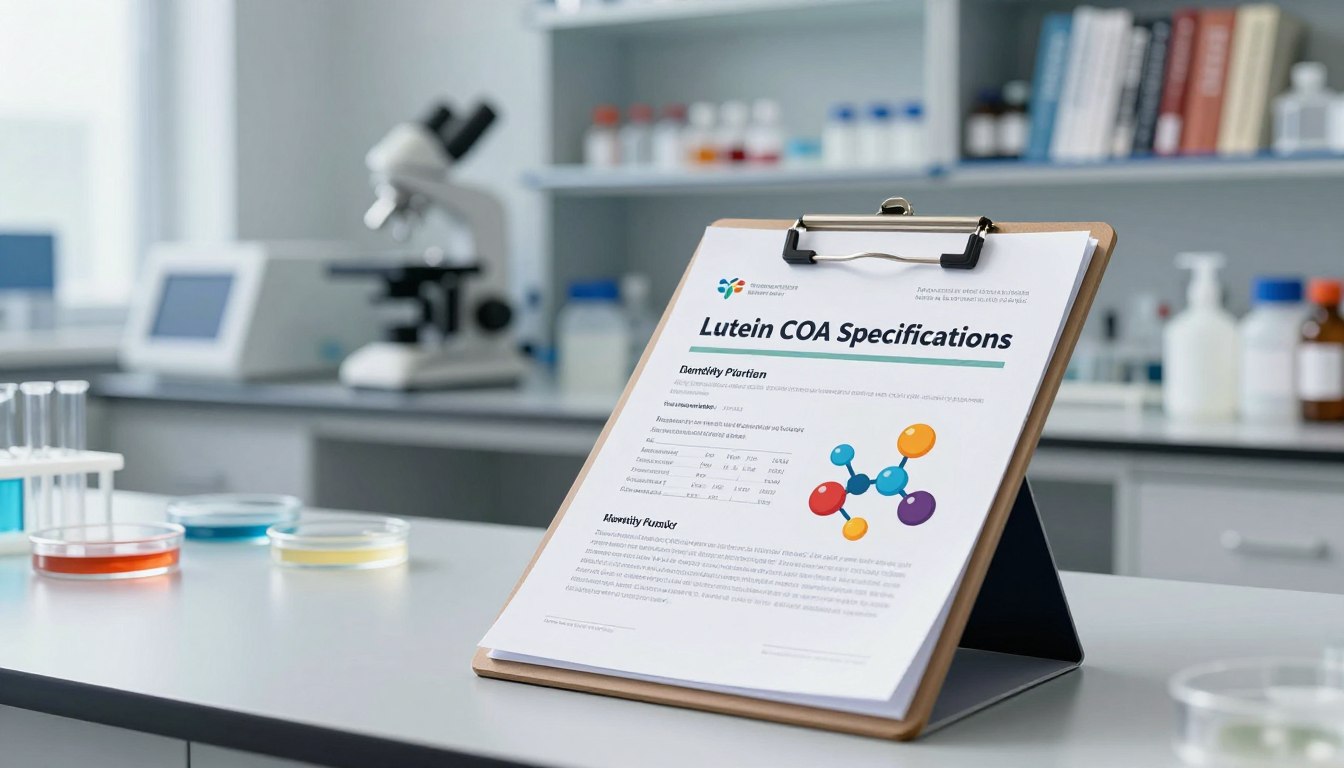
A detailed scene illustrating "Lutein COA Specifications" on a sleek, modern desk. In the foreground, prominently displayed is a neatly organized clipboard with a stylized certificate showcasing identity and purity standards, including vibrant diagrams of lutein molecules. The middle layer features a high-tech lab environment, with laboratory equipment and petri dishes subtly visible, emphasizing a focus on purity and analysis. The background reveals shelves filled with scientific books and vials in a well-lit laboratory setting, enhancing the atmosphere of professionalism and precision. Soft, natural lighting overhead creates a clean, inviting ambiance, while a slight depth of field draws attention to the clipboard in the foreground. The overall mood is informative and serious, making it suitable for an academic article.
Specification | Description | Importance |
Lutein Content Percentage | Percentage of Lutein in the product | Indicates potency and effectiveness |
Lutein to Zeaxanthin Ratio | Ratio of Lutein to Zeaxanthin isomers | Affects product efficacy and quality |
Physical Properties | Color, odor, and appearance | Indicators of quality and potential contamination |
Chemical Properties | Solubility and stability | Critical for shelf life and bioavailability |
Analytical Testing Methods to Confirm in Your Lutein COA
To ensure Lutein products are good and real, it's key to know the testing methods. These methods check if the product has the right quality and amount of Lutein. They make sure the product is pure and potent.
Accurate Lutein Identification through HPLC Analysis
High-Performance Liquid Chromatography (HPLC) is a top-notch way to identify and quantify Lutein. HPLC analysis is vital for verifying the presence and concentration of Lutein. It ensures the product contains the correct amount of active ingredient.
HPLC helps separate and identify each component in a mixture. It provides a detailed profile of the Lutein product. This method is highly precise and crucial for quality control.
UV-Vis Spectroscopy for Purity Confirmation
UV-Vis spectroscopy is also essential for confirming Lutein purity. It measures how much light a sample absorbs. UV-Vis spectroscopy can detect any impurities present in the product.
The purity of Lutein is checked by looking at the light absorption spectrum. This tells us about the compound's structure. It's great for spotting any impurities that could harm the product's safety or efficacy.
Assessing Particle Size Distribution and Bioavailability
The size of Lutein particles affects how well it works in the body. Particle size analysis ensures the product has the optimal size for best results.
Particle Size Range (μm) | Bioavailability Impact |
0.1 - 1 | High bioavailability due to increased surface area |
1 - 10 | Moderate bioavailability; suitable for most applications |
>10 | Low bioavailability; may require additional processing |
Moisture Content and Loss on Drying Analysis
Moisture content is crucial for Lutein product stability and shelf-life. Loss on Drying (LOD) analysis measures moisture by determining the weight loss upon drying.
By keeping moisture levels right, manufacturers can prevent degradation. This ensures the product remains stable and performs well over time. This test is crucial for maintaining product quality and efficacy.
Safety and Contaminant Limits: Critical COA Parameters
To ensure Lutein quality and safety, it is essential to review the Certificate of Analysis (COA). The COA outlines the product's purity, potency, and safety. These are vital for meeting standards and ensuring customer well-being.
When considering Lutein safety, contaminants are a significant concern. These can include heavy metals, pesticides, microbes, and solvents. If not managed, they can pose health risks.
Heavy Metals Testing: Lead, Arsenic, Mercury, and Cadmium
Heavy metals like lead, arsenic, mercury, and cadmium are harmful. It's important to see if the Lutein COA tests for these. Regulatory limits guide how much of these metals are allowed in products.
Key heavy metals to test for include:
- Lead (Pb)
- Arsenic (As)
- Mercury (Hg)
- Cadmium (Cd)
Pesticide Residue Screening and Maximum Limits
Pesticide residues are also a concern in Lutein products. The COA should show pesticide screening and confirm levels are within limits. This ensures the product is safe and meets global standards.
Common pesticides to be screened include:
- Organophosphates
- Organochlorines
- Pyrethroids
Microbial Contamination: Total Plate Count and Pathogens
Microbial contamination is a major safety factor. The COA should report total plate counts and specific pathogen tests. High contamination levels can make a product unsafe.
Microbial tests typically include:
- Total Plate Count (TPC)
- Yeast and Mold Count
- Pathogen testing (e.g., Salmonella, E. coli)
Residual Solvents and Extraction Chemical Verification
The COA should also verify residual solvents and extraction chemicals. These can be detrimental in high concentrations. Their limits are strictly regulated.
An informative graphical representation of Lutein COA safety parameters, focusing on critical contaminant limits. In the foreground, illustrate a neat checklist with ticked boxes, blending elements like safety shields and chemical hazard symbols. In the middle, visualize a stylized laboratory environment with scientific equipment, such as test tubes and analytical instruments, conveying a sense of meticulous testing. In the background, softly lit shelves display vials of Lutein and other natural compounds, suggesting a professional setting. The lighting should be bright yet soft, creating a clean and sterile atmosphere, accentuating the importance of compliance and safety in a business-like environment. No text or logos should appear in the image, ensuring it remains focused on the visual themes.
By examining the COA for these key safety factors, importers can ensure Lutein products are safe and effective. This careful review helps meet standards and build customer trust.
Compliance Documentation: What Your Lutein COA Must Include
To stay ahead, Lutein importers need to make sure their COA follows all rules. A detailed COA is more than a paper; it's a promise of quality and safety. It's key for checking if the Lutein supplement is safe to eat.
Mandatory COA Documentation Elements and Batch Information
A good COA for Lutein needs certain details and batch info. It should list the product name, batch number, and when it was made. It also needs to show test results for quality and strength.
The batch info is important for tracking and quality checks. It helps keep the product's path clear and fixes any problems fast.
FDA, USP, and International Regulatory Compliance Standards
Lutein COA supplements must follow FDA and USP rules. These rules make sure the product is safe and meets quality standards.
It's also key to follow international rules since Lutein is sold worldwide. Importers need to know the rules in their market and make sure their COA meets them.
Regulatory Body | Standards | Compliance Requirements |
FDA | 21 CFR Part 111 | Good Manufacturing Practices (GMPs) |
USP | USP Dietary Supplement Monographs | Identity, Purity, Potency, and Performance |
International | ISO, Codex Alimentarius | Globally Harmonized System (GHS) compliance |
Third-Party Laboratory Certification and Accreditation
Obtaining a Certificate of Analysis (COA) from a third-party laboratory is crucial. Laboratories must be certified by ISO/IEC 17025 to demonstrate that their tests are reliable and adhere to global standards.
This certification signifies that the test results are dependable. It instills confidence in importers regarding the quality of their Lutein supplements.
Supplier Traceability and Source Verification
It is essential to ascertain the origin of the Lutein. Importers must verify the source and ensure that suppliers comply with regulations and best practices.
By ensuring their COA is complete and suppliers are reliable, importers can remain competitive. They can also guarantee their Lutein supplements are safe and of high quality.
Conclusion
Checking Lutein COA is key to ensuring the quality and safety of Lutein products. This is important in foods where lutein COA in foods matters a lot. By following the checklist in this article, importers can protect their business and customers from bad quality Lutein.
Knowing about Lutein COA specifications, like lutein coa dosage and lutein coa side effects, helps importers make smart choices. It's important to check COA thoroughly to keep business standards high. This also helps avoid financial and legal problems.
Our study shows that checking Lutein COA is vital for following rules and ensuring safety in products. If you're looking to buy lutein coa, checking the COA is a must. We also suggest more research to keep improving quality checks.
FAQ
What exactly is a Lutein COA and why must we verify it before importing?
A Certificate of Analysis (COA) is a key document from makers like Kemin Industries or OmniActive Health Technologies. It proves a Lutein batch meets its promised standards. We check this to make sure the Lutein is real, strong, and clean. Without a verified COA, we might get low-quality ingredients, leading to recalls or legal trouble with the FDA.
What are the primary lutein COA benefits we should look for in the documentation?
We look for proof of high bioavailability and nutrient density in the COA. A detailed COA shows the lutein COA supplements we make will help eye health. This means our customers get a reliable and effective product.
How do we confirm the purity of different lutein COA sources?
Most lutein comes from Marigold flowers (*Tagetes erecta*). We check the COA for HPLC results. This method helps us see if the lutein is real and not mixed with cheaper, fake stuff.
Does the COA provide information on lutein COA in foods versus extracts?
The COA for extracts focuses on concentration, unlike food sources. We compare the extract's profile to natural foods. This ensures our concentrated Lutein is in the best form for the body to absorb.
How do we use the COA to determine the correct lutein COA dosage for our products?
The dosage depends on the "assay" value in the COA. For example, if it says 20% Lutein, we figure out how much raw material we need. This ensures our products meet USP standards and research like the AREDS2 study.
Are there any lutein COA side effects we can prevent by checking the COA?
Yes, we can avoid side effects by checking the COA's "Safety and Contaminants" section. We make sure heavy metals, pesticides, and solvents are safe. This protects our customers from harmful reactions.
What should we look for regarding lutein coa research and testing methods?
Look for COAs that use USP or JECFA methods. Good research shows a 5:1 Lutein to Zeaxanthin ratio is best for eyes. So, we check the COA for Zeaxanthin content alongside Lutein.
Where is the most reliable place to buy lutein coa verified raw materials?
For reliable ingredients, buy from trusted suppliers like BASF or Zhuangmei Herb. Always ask for a pre-shipment sample and a COA verified by Eurofins. This ensures the product matches the paperwork.
What are the physical and chemical properties we should verify on the checklist?
Our checklist includes verifying color, odor, and particle size. We also check stability and solubility. These details help our team make sure the Lutein works well in our products, like softgels or powders.
Why is third-party laboratory certification mentioned on a Lutein COA?
Third-party certification from labs like ISO/IEC 17025 adds security. It shows the manufacturer's results are checked by an outside expert. This is key for our quality assurance to meet top standards.
PHONE
EMAIL
WhatsApp